

Executive summary
Despite years of investment in student information systems, CRM tools, and digital portals, many university admissions teams still run their day-to-day operations on email threads, Excel sheets, and shared folders. This is not a failure of technology adoption. It is a structural gap in how admissions work is designed and executed.
This article unpacks why email and spreadsheets persist, why they are increasingly risky at scale, and how universities are addressing the gap through university admissions workflow automation without destabilizing their core academic systems.
The uncomfortable reality in admissions offices
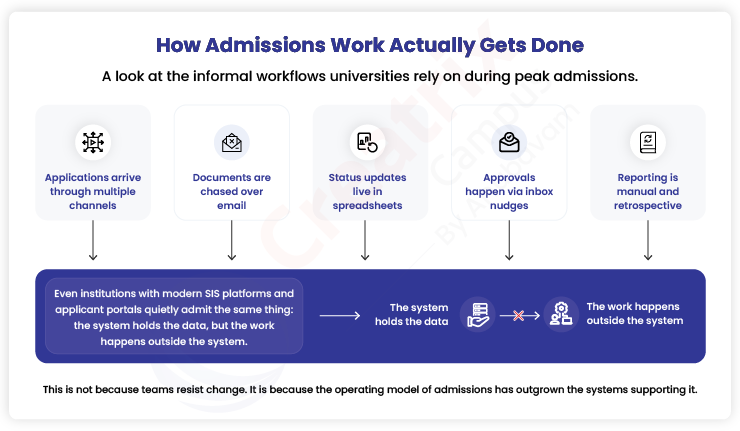
Across universities, the pattern is strikingly consistent:
- Applications arrive through multiple channels
- Documents are chased over email
- Status updates live in spreadsheets
- Approvals happen via inbox nudges
- Reporting is manual and retrospective
Without university admissions workflow automation, teams are forced to manage approvals, follow-ups, and decisions outside the system of record.
What universities lack today is not software, but university admissions workflow automation that reflects how admissions work actually happens.
Why email and spreadsheets refuse to die
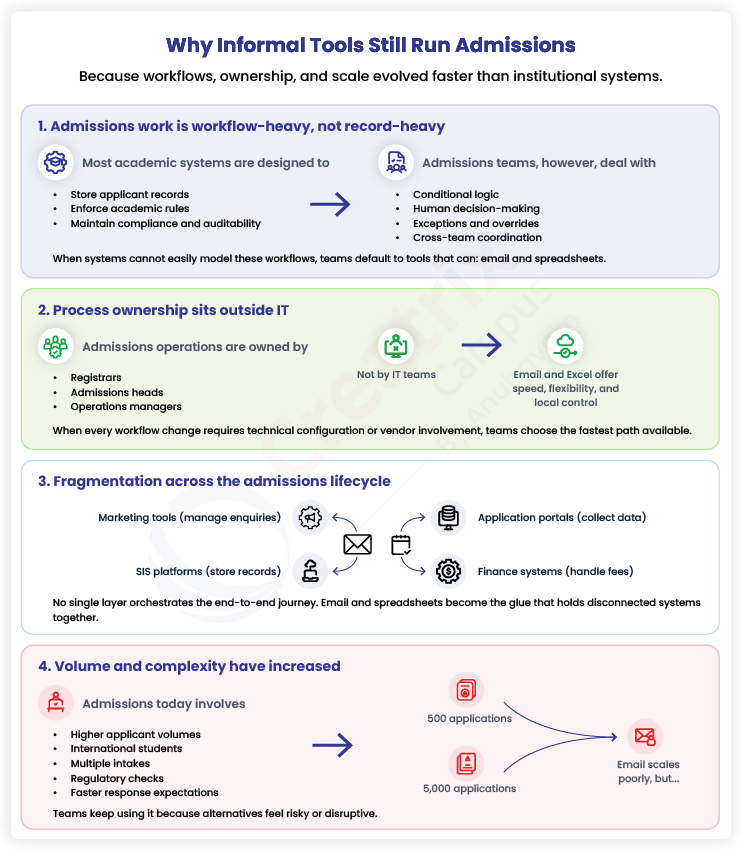
1. Admissions work is workflow-heavy, not record-heavy
Most academic systems are designed to:
- Store applicant records
- Enforce academic rules
- Maintain compliance and auditability
Admissions teams, however, deal with:
- Conditional logic
- Human decision-making
- Exceptions and overrides
- Cross-team coordination
This is where university admissions workflow automation becomes critical, because admissions work is driven by decisions, exceptions, and coordination.
Traditional systems fail not because they store data poorly, but because they do not support university admissions workflow automation at scale.
This gap is especially visible in complex higher education admissions workflows that involve conditional decisions, exceptions, and cross-team coordination.
2. Process ownership sits outside IT
Admissions operations are owned by:
- Registrars
- Admissions heads
- Operations managers
Not by IT teams.
When every workflow change requires technical configuration or vendor involvement, effective admissions operations management becomes impossible at scale.
3. Fragmentation across the admissions lifecycle
In most universities:
- Marketing tools manage enquiries
- Application portals collect data
- SIS platforms store records
- Finance systems handle fees
No single layer orchestrates the end-to-end journey. Email and spreadsheets become the glue that holds disconnected systems together.
4. Volume and complexity have increased
Admissions today involves:
- Higher applicant volumes
- International students
- Multiple intakes
- Regulatory checks
- Faster response expectations
What worked for 500 applications collapses at 5,000. Email scales poorly, but teams keep using it because alternatives feel risky or disruptive.
As applicant volumes grow and intake models diversify, student recruitment operations have become time-critical, high-risk functions rather than back-office processes.
The hidden cost of email- and spreadsheet-led admissions
The absence of university admissions workflow automation creates operational blind spots that directly affect yield, compliance, and staff burnout.
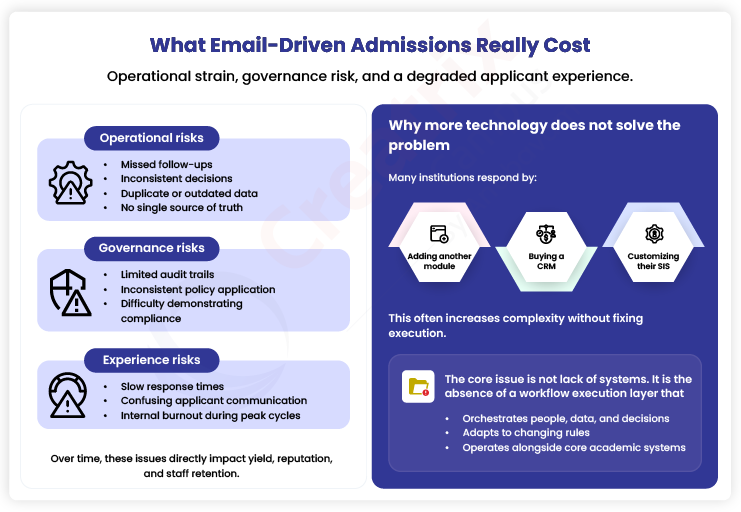
Operational risks
- Missed follow-ups
- Inconsistent decisions
- Duplicate or outdated data
- No single source of truth
Governance risks
- Limited audit trails
- Inconsistent policy application
- Difficulty demonstrating compliance
Experience risks
- Slow response times
- Confusing applicant communication
- Internal burnout during peak cycles
Over time, these issues directly impact yield, reputation, and staff retention.
Why does more technology not solve the problem
Many institutions respond by:
- Adding another module
- Buying a CRM
- Customizing their SIS
This often increases complexity without fixing execution.
The core issue is not lack of systems. It is the absence of a workflow execution layer that:
- Orchestrates people, data, and decisions
- Adapts to changing rules
- Operates alongside core academic systems
How forward-looking universities are fixing it
Forward-looking institutions are addressing this gap through university admissions workflow automation, rather than replacing their SIS.
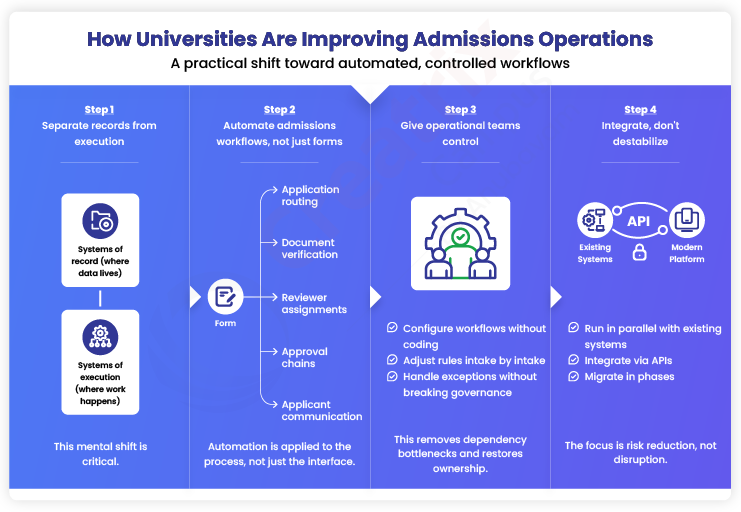
Step 1: Separate records from execution
They distinguish between:
- Systems of record (where data lives)
- Systems of execution (where work happens)
This mental shift is critical.
Step 2: Automate admissions workflows, not just forms
Instead of digitizing forms, they automate:
- Application routing
- Document verification
- Reviewer assignments
- Approval chains
- Applicant communication
Automation is applied to the process, not just the interface, shifting institutions toward true admissions process automation rather than isolated digitisation.
Step 3: Give operational teams control
Modern execution platforms allow admissions and registry teams to:
- Configure workflows without coding
- Adjust rules intake by intake
- Handle exceptions without breaking governance
This removes dependency bottlenecks and restores ownership.
Step 4: Integrate, don’t destabilize
Successful transformations:
- Run in parallel with existing systems
- Integrate via APIs
- Migrate in phases
The focus is risk reduction through deliberate admissions system integration, not disruption of existing academic or finance platforms.
What changes when email and spreadsheets disappear from the core workflow
Institutions that make this shift consistently report:
- 30–40% reduction in processing time
- Clear, real-time visibility across the funnel
- Fewer manual interventions
- Stronger compliance posture
- Better applicant experience
Most importantly, admissions teams move from firefighting to flow management — with clearer ownership, calmer peak cycles, and confidence in every decision.
A closing perspective for registrars and admissions leaders
If email and spreadsheets are still central to your admissions process, the problem is not discipline or training.
It is architecture.
This is why university admissions workflow automation is becoming a defining capability for modern universities, enabling institutions to separate records from execution and operate with clarity, control, and confidence at scale.
The question is no longer whether to change, but where to start.
This is why execution-layer thinking is becoming a defining capability for modern universities, enabling automation without disruption, and progress without compromise.
- Log in to post comments