

What is Degree Audit, Planning, and Credentialing Alignment?
Degree audit, planning, and credentialing alignment refers to the ability of academic planning, validation, and credential issuance processes to operate on the same academic rules and recognition logic.
When aligned, student progression, outcome validation, and credential recognition remain consistent across the academic lifecycle. When disconnected, institutions face recognition disputes, manual reconciliation, delayed credential issuance, and accreditation risk.
For registrars, the risk is recognition inconsistency.
For accreditation teams, the risk is evidence that cannot be reconciled across systems.
For academic leaders, the risk is expanding modular programmes faster than the institution can govern them.
As micro-credentials, stackable pathways, and alternative credentials become more common, the challenge is no longer creating new learning opportunities. The challenge is ensuring that planning, validation, and recognition remain aligned as academic complexity increases.
Three Systems Built for a World That No Longer Exists
For decades, universities ran degree audit, academic planning, and credentialing as three distinct functions. Audit confirmed completion. Planning mapped the route. Credentialing issued recognition at the end.
Each did its job, and the seams between them rarely showed because degrees were linear, and a linear degree only crosses those seams once, at graduation.
That assumption no longer holds.
Micro-credentials, stackable credentials, and modular programs have redefined how students progress.
International frameworks supporting micro-credentials and flexible learning pathways continue to accelerate this shift across higher education.
Learning now accumulates across multiple layers, entry points, and timelines. Students earn a module that counts toward several outcomes, pause, return, stack one credential onto another, and redirect entirely.
Progression has become non-linear, and three systems that only ever had to agree once now have to agree continuously.
They do not. And where they disagree, governance gaps open.
Key Takeaways
- The linear-degree assumption baked into audit, planning, and credentialing no longer reflects how students actually progress.
- Degree audit can no longer wait until graduation to validate. It has to recognize micro-credentials and interim awards in real time.
- Credentialing has become continuous, not terminal. Badges and competency awards issue throughout the journey, not only at the end.
- When these three functions run on disconnected systems, the cost is not inconvenience. It is recognition disputes, inconsistent records, and accreditation exposure.
1. Linear Degree Architecture No Longer Reflects Reality
Traditional planning tools assumed a single fixed sequence and tracked semester-by-semester progression. Audit systems confirmed credit totals at the end. The model was coherent because the path was coherent.
Stackable and short-form programs broke that coherence. A student might earn a micro-credential first, apply it toward a certificate, then stack it toward a degree, or never complete the degree at all, and still walk away with recognized, portable learning.
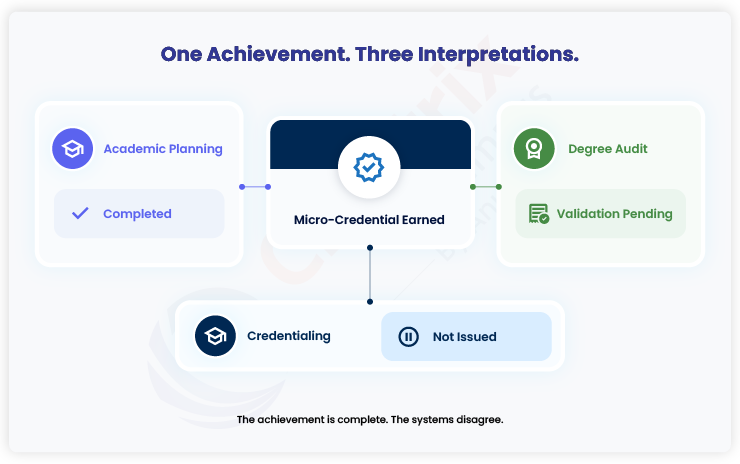
When the three functions interpret that journey independently, they diverge. Planning may register the module as complete. Audit may not recognize it toward any award. Credentialing may have nothing to issue because no system told it the outcome was verified.
The student has progressed. The institution's records say three different things.
Connecting these functions is what turns scattered credentials into an intentional academic structure rather than a pile of unreconciled records.
2. Degree Audit Must Validate More Than Degrees
Audit systems were built to answer one question: has the student completed the degree?
A traditional student information system can record student status, but modular validation requires connected academic rules across audit, planning, and credentialing.
In 2026, that question is too narrow. Audit now has to validate competencies, interim awards, and stackable credentials. It has to do this continuously because recognition cannot wait for graduation when the credential is the point.
Here is where the disconnect becomes concrete.
Consider a common example. A student earns a cybersecurity micro-credential that should count toward a postgraduate certificate. Academic planning shows the student is eligible, but the audit engine does not recognize the module because the credential mapping was updated in only one system. The student completes the pathway, yet credential issuance is delayed while staff manually validate completion.
The student has completed the learning. The institution's systems simply disagree on what counts.
The student experiences a delay the institution cannot explain, and the registrar's office absorbs reconciliation work that should not exist.
When audit validates against the same logic that credentialing issues from, that confirmation happens the moment the outcome is verified, not weeks later by hand.
3. Academic Planning Must Model Stackable Pathways
Planning can no longer be a static map of one route. It now has to work as part of curriculum governance, where pathways, validation rules, and credential outcomes stay aligned as programmes become more modular.
That only works if planning is connected to what audit actually validates and what credentialing actually issues.
When planning runs in isolation, it shows students pathways the audit engine will not honor, promising a route that does not reconcile when they try to walk it.
The mismatch surfaces at the worst possible moment: when a student believes they have completed something the system will not recognize.
Connected, planning reflects reality. Isolated, it generates expectations the rest of the institution cannot meet.
4. Credentialing Is No Longer a Terminal Event
Credentialing used to happen once, at graduation.
Now universities issue badges, interim awards, and competency-based recognition throughout a student's progression. Credentialing runs in parallel with learning, not after it.
When the credentialing system operates independently of audit, two failures follow.
Credentials issue inconsistently because there is no single source of truth for what has been verified.
Duplication creeps in as the same achievement gets recorded differently across systems that were never reconciled.
In a connected lifecycle, what is planned can be validated, and what is validated can be credentialed automatically from verified outcomes, rather than from manual reconciliation between systems that do not trust each other's data.
5. Siloed Systems Are an Accreditation Exposure
The risk here is not abstract. In 2026, it is increasingly regulatory.
Manual reconciliation between audit and planning multiplies error. Disconnected credentialing creates verification gaps.
Accreditation reviews increasingly probe exactly this question: can you demonstrate that your recognition logic is consistent, and that what you planned, validated, and credentialed actually agree?
Frameworks across regions now expect institutions to evidence the integrity of their credential recognition, not just assert it. The CAA in the UAE, MQA in Malaysia, and US accreditors under continuous-evidence expectations all care whether a stackable credential recognized in one system is recognized identically across the others.
The problem often surfaces during accreditation reviews. Credential completion records may come from one system while audit records come from another, only for reviewers to discover that the totals do not reconcile. Staff then spend days rebuilding evidence trails that should have existed automatically.
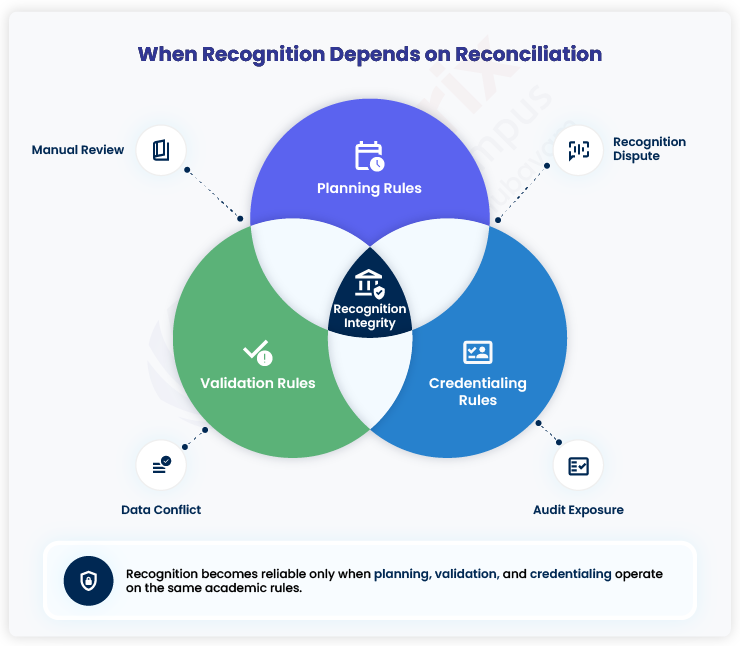
Connecting them prevents the failures that show up in a review: recognition disputes, data inconsistencies, audit vulnerability, and delayed credential issuance.
The Integrated Academic Lifecycle
The fix is not a fourth tool bolted beside the other three. It is shared logic across the whole progression:
Design → Plan → Audit → Validate → Credential → Stack
Each stage informs the next. None operates in isolation.
A credential issued at the end of one cycle becomes a validated input to the next, and the audit engine recognizes it because it was generated within the same connected lifecycle, not imported across a system boundary and manually reconciled.
Conclusion: Alignment Is Infrastructure, Not Innovation
Micro-credentials did not create this complexity. They exposed it.
Audit, planning, and credentialing were designed for stable, linear programs, and modular growth simply revealed that they were never connected in the first place.
Institutions that connect these functions gain clarity in validation, consistency in credentialing, and resilience in how they manage progression.
Those that do not will keep reconciling by hand and keep carrying the accreditation risk that comes with systems that disagree.
This is where the architecture matters.
Creatrix Campus is an Academic Operating System: planning, audit, validation, and credential issuance run on one governed model, so a credential recognized in one lifecycle is recognized across all of them without the manual reconciliation that disconnected tools require.
Institutions manage modular growth without fragmenting oversight because oversight was never fragmented to begin with.
This ensures that planning decisions, outcome validation, and credential recognition are governed by the same institutional rules rather than separate departmental processes.
In 2026, alignment is not a feature. It is the infrastructure modular education runs on.
Frequently Asked Questions
- Log in to post comments
progression, academic validation, and credential recognition operate using the
same academic rules and recognition logic. As micro-credentials, stackable
pathways, and modular programs become more common, institutions must ensure
that what is planned can be validated, and what is validated can be credentialed
consistently. Without alignment, institutions face recognition disputes,
delayed credential issuance, manual reconciliation, and accreditation risk.
planning, and credentialing as separate functions because student progression
followed linear degree pathways. Modern learning models have changed this
assumption. Micro-credentials, competency-based education, stackable awards,
digital badges, and modular programs require continuous validation and
recognition throughout the student lifecycle. When planning, audit, and
credentialing systems operate independently, they often interpret student
achievement differently, creating inconsistencies in progression tracking,
credential recognition, and accreditation evidence. An integrated academic
lifecycle connects curriculum design, academic planning, degree audit,
outcome validation, credential issuance, and stackable learning pathways
through shared governance rules, ensuring consistent recognition, automated
credentialing, regulatory compliance, and scalable academic operations.
pathways, validation rules, and credential recognition remain consistent
across the student journey. Institutions improve governance, reduce manual
reconciliation, and support modular learning when these functions operate
on a shared academic framework rather than disconnected systems.
{
"@context": "https://schema.org",
"@graph": [
{
"@type": "Organization",
"@id": "https://www.anubavam.com/#organization",
"name": "Anubavam Technologies Pvt Ltd",
"url": "https://www.anubavam.com/",
"subOrganization": {
"@id": "https://www.creatrixcampus.com/#organization"
}
},
{
"@type": "Organization",
"@id": "https://www.creatrixcampus.com/#organization",
"name": "Creatrix Campus",
"url": "https://www.creatrixcampus.com/",
"description": "AI-native Academic Operating System for higher education institutions.",
"parentOrganization": {
"@id": "https://www.anubavam.com/#organization"
},
"brand": {
"@id": "https://www.creatrixcampus.com/#brand"
},
"sameAs": [
"https://www.linkedin.com/showcase/creatrix-campus/",
"https://www.youtube.com/@creatrixcampus",
"https://www.facebook.com/creatrixcampus",
"https://www.instagram.com/creatrixcampus",
"https://x.com/creatrixcampus"
],
"knowsAbout": [
"Higher Education Software",
"Academic Management",
"Student Lifecycle Management",
"Student Information System",
"Academic Planning",
"Degree Audit",
"Digital Credentialing",
"Institutional Governance",
"Curriculum Management",
"Academic Operations"
],
"areaServed": [
{ "@type": "Place", "name": "Middle East" },
{ "@type": "Country", "name": "United States" },
{ "@type": "Country", "name": "Canada" },
{ "@type": "Country", "name": "Mexico" },
{ "@type": "Place", "name": "Europe" },
{ "@type": "Country", "name": "Malaysia" },
{ "@type": "Country", "name": "Singapore" },
{ "@type": "Country", "name": "Australia" },
{ "@type": "Country", "name": "New Zealand" },
{ "@type": "Country", "name": "Philippines" }
],
"contactPoint": {
"@type": "ContactPoint",
"contactType": "Sales",
"email": "info@creatrixcampus.com",
"availableLanguage": "English"
}
},
{
"@type": "Brand",
"@id": "https://www.creatrixcampus.com/#brand",
"name": "Creatrix Campus",
"url": "https://www.creatrixcampus.com/"
},
{
"@type": "Audience",
"@id": "https://www.creatrixcampus.com/#audience",
"audienceType": "Higher Education Institutions"
},
{
"@type": "EducationalAudience",
"@id": "https://www.creatrixcampus.com/#educationalaudience",
"educationalRole": [
"University President",
"Vice Chancellor",
"Provost",
"Dean",
"Registrar",
"Academic Administrator",
"Student Success Team",
"Institutional Effectiveness Team",
"Academic Advisor",
"Curriculum Leader"
]
},
{
"@type": "Person",
"@id": "https://www.creatrixcampus.com/#team-creatrix",
"name": "Team Creatrix",
"worksFor": {
"@id": "https://www.creatrixcampus.com/#organization"
}
},
{
"@type": "WebSite",
"@id": "https://www.creatrixcampus.com/#website",
"url": "https://www.creatrixcampus.com/",
"name": "Creatrix Campus",
"publisher": {
"@id": "https://www.creatrixcampus.com/#organization"
},
"potentialAction": {
"@type": "SearchAction",
"target": "https://www.creatrixcampus.com/search?search={search_term_string}",
"query-input": "required name=search_term_string"
}
},
{
"@type": "ImageObject",
"@id": "https://www.creatrixcampus.com/blog/degree-audit-and-credentialing-integration#primaryimage",
"url": "https://www.creatrixcampus.com/blog/degree-audit-and-credentialing-integration",
"caption": "Why Degree Audit, Planning, and Credentialing Can No Longer Operate Separately in 2026"
},
{
"@type": "WebPage",
"@id": "https://www.creatrixcampus.com/blog/degree-audit-and-credentialing-integration#webpage",
"url": "https://www.creatrixcampus.com/blog/degree-audit-and-credentialing-integration",
"name": "Why Degree Audit, Planning, and Credentialing Can No Longer Operate Separately in 2026",
"isPartOf": {
"@id": "https://www.creatrixcampus.com/#website"
},
"primaryImageOfPage": {
"@id": "https://www.creatrixcampus.com/blog/degree-audit-and-credentialing-integration#primaryimage"
},
"breadcrumb": {
"@id": "https://www.creatrixcampus.com/blog/degree-audit-and-credentialing-integration#breadcrumb"
},
"audience": {
"@id": "https://www.creatrixcampus.com/#educationalaudience"
},
"mainEntity": {
"@id": "https://www.creatrixcampus.com/blog/degree-audit-and-credentialing-integration#blogposting"
},
"speakable": {
"@type": "SpeakableSpecification",
"cssSelector": [
"#direct-answer",
"#ai-retrieval-summary",
"#speakable-summary"
]
},
"inLanguage": "en"
},
{
"@type": "BlogPosting",
"@id": "https://www.creatrixcampus.com/blog/degree-audit-and-credentialing-integration#blogposting",
"mainEntityOfPage": {
"@id": "https://www.creatrixcampus.com/blog/degree-audit-and-credentialing-integration#webpage"
},
"headline": "Why Degree Audit, Planning, and Credentialing Can No Longer Operate Separately in 2026",
"description": "This article explains why degree audit, academic planning, and credentialing alignment are critical for higher education institutions managing modular learning, stackable credentials, and non-linear student progression.",
"datePublished": "2026-02-17",
"dateModified": "2026-02-17",
"author": {
"@id": "https://www.creatrixcampus.com/#team-creatrix"
},
"publisher": {
"@id": "https://www.creatrixcampus.com/#organization"
},
"image": {
"@id": "https://www.creatrixcampus.com/blog/degree-audit-and-credentialing-integration#primaryimage"
},
"articleSection": "General",
"audience": {
"@id": "https://www.creatrixcampus.com/#educationalaudience"
},
"educationalUse": "Academic Planning, Degree Audit, and Credentialing Alignment",
"keywords": [
"degree audit",
"academic planning",
"credentialing",
"digital credentialing",
"stackable credentials",
"micro-credentials",
"academic lifecycle",
"student progression tracking",
"higher education governance"
],
"about": [
{ "@type": "Thing", "name": "Degree audit systems" },
{ "@type": "Thing", "name": "Academic planning systems" },
{ "@type": "Thing", "name": "Digital credentialing systems" },
{ "@type": "Thing", "name": "Stackable credentials" },
{ "@type": "Thing", "name": "Micro-credentials" },
{ "@type": "Thing", "name": "Integrated academic lifecycle" }
],
"mentions": [
{ "@type": "Thing", "name": "Academic pathway modeling" },
{ "@type": "Thing", "name": "Credential validation frameworks" },
{ "@type": "Thing", "name": "Non-linear academic progression management" },
{ "@type": "Thing", "name": "Governance risks of siloed academic systems" },
{
"@type": "SoftwareApplication",
"@id": "https://www.creatrixcampus.com/student-information-system#software",
"name": "Creatrix Campus Student Information System",
"applicationCategory": "Higher Education Software",
"operatingSystem": "Web",
"url": "https://www.creatrixcampus.com/student-information-system",
"provider": {
"@id": "https://www.creatrixcampus.com/#organization"
}
}
],
"inLanguage": "en"
},
{
"@type": "BreadcrumbList",
"@id": "https://www.creatrixcampus.com/blog/degree-audit-and-credentialing-integration#breadcrumb",
"itemListElement": [
{
"@type": "ListItem",
"position": 1,
"name": "Home",
"item": "https://www.creatrixcampus.com/"
},
{
"@type": "ListItem",
"position": 2,
"name": "Blog",
"item": "https://www.creatrixcampus.com/blog"
},
{
"@type": "ListItem",
"position": 3,
"name": "Why Degree Audit, Planning, and Credentialing Can No Longer Operate Separately in 2026",
"item": "https://www.creatrixcampus.com/blog/degree-audit-and-credentialing-integration"
}
]
},
{
"@type": "FAQPage",
"@id": "https://www.creatrixcampus.com/blog/degree-audit-and-credentialing-integration#faq",
"mainEntityOfPage": {
"@id": "https://www.creatrixcampus.com/blog/degree-audit-and-credentialing-integration#webpage"
},
"mainEntity": [
{
"@type": "Question",
"name": "Why must degree audit and credentialing align in 2026?",
"acceptedAnswer": {
"@type": "Answer",
"text": "Modular and stackable credentials require continuous validation, not end-stage reconciliation."
}
},
{
"@type": "Question",
"name": "How do micro-credentials affect degree audit systems?",
"acceptedAnswer": {
"@type": "Answer",
"text": "They require a degree audit for micro-credentials and integrated validation logic."
}
},
{
"@type": "Question",
"name": "What happens when planning and audit remain separate?",
"acceptedAnswer": {
"@type": "Answer",
"text": "Student progression tracking becomes inconsistent, and credential recognition delays increase."
}
},
{
"@type": "Question",
"name": "Is credentialing still a graduation-only process?",
"acceptedAnswer": {
"@type": "Answer",
"text": "No. Digital credentialing systems now operate during progression, not only at completion."
}
},
{
"@type": "Question",
"name": "What defines an integrated academic lifecycle?",
"acceptedAnswer": {
"@type": "Answer",
"text": "A system where planning, audit, validation, and credentialing share aligned logic."
}
}
]
}
]
}
</script>