

Introduction: Why Compliance Alone Isn’t Enough in 2026
In 2026, compliance alone won’t keep a university competitive. Or accredited.
That message came through loud and clear during our roundtable sessions with Malaysian higher education leaders, including QA directors, planning officers, and Vice Chancellors from top institutions like UKM, UTHM, and UniMAP in Malaysia.
81% of QA leaders said their institutions still rely on disconnected systems for evidence collection.
60% said accreditation prep takes too long and always starts too late.
And nearly 70% of strategy officers shared that digital transformation efforts stall due to siloed workflows and unclear audit readiness.
Even with systems like Student Information System (SIS), Learning Management System (LMS), and QA tools, most institutions are still reacting, not leading.
The reason? Higher education digital transformation in Malaysia has focused too long on checklists, not continuity.
It’s time to shift the strategy.
This blog breaks down the 7 core priorities Malaysian HE leaders are now aligning around, based on recent Creatrix-led discussions, emerging AI trends, and evolving MQA compliance system requirements.
If you're responsible for strategic planning for universities, accreditation, or digital campus systems; these insights are your new playbook.
Key Takeaways: What Malaysian HE Leaders Want in 2026
- Continuity, not just compliance
- Integrated AI that drives insight, not just data
- Real-time readiness for audits, not annual stress
- Alignment with MOHE, MyRA, MQA, and internal strategy
- Faculty and QA working from shared systems
- Less admin load, more institutional clarity
From MQA Compliance to Strategic Continuity
What Malaysian HE leaders need for compliance in 2026
MQA compliance isn’t going away, but how it's achieved is changing fast.
For Malaysian HE leaders, it’s no longer just about meeting benchmarks every 2–5 years.
It’s about staying ready every day; even with hybrid learning and limited resources.
Continuity now means:
• Academic programs that auto-align with CLOs
• QA teams that don’t wait for evidence, they see it live
• Planning offices that can act, not react
That’s where modern systems matter.
Creatrix powers real-time validation, role-based audit trails, and connected QA–academic–planning logic, built for Malaysian continuity, not just compliance.
What’s Driving the Shift in Malaysia’s Higher Ed Sector?
That was the clear consensus from QA heads, planners, and VCs in our recent roundtable.
Compliance isn’t enough. Continuity is the new standard.
Here’s why:
ODL expansion + MyDigital Blueprint
Quality assurance in education becomes even more complex with ODL, especially when evidence is scattered across disconnected systems.
The MQA now expects real-time readiness, not after-the-fact prep.
“We used to prepare for audits. Now, we’re expected to be audit-ready, every day,” shared a Director of QA from a Malaysian public university.
MyRA & SETARA = Strategic Scorecards
These frameworks now shape rankings, funding, and public trust.
Manual evidence collection? It’s no longer viable.
Leadership Shift: From Tools to Intelligence
“We don’t need more dashboards; we need decisions that don’t depend on chasing five systems.” – Vice Chancellor, Private HEI.
Today, the real differentiator is a digital campus systems that connects QA, curriculum, and planning through AI, not more modules.
Top 7 Priorities for Digital Continuity in Malaysian Universities (2026)
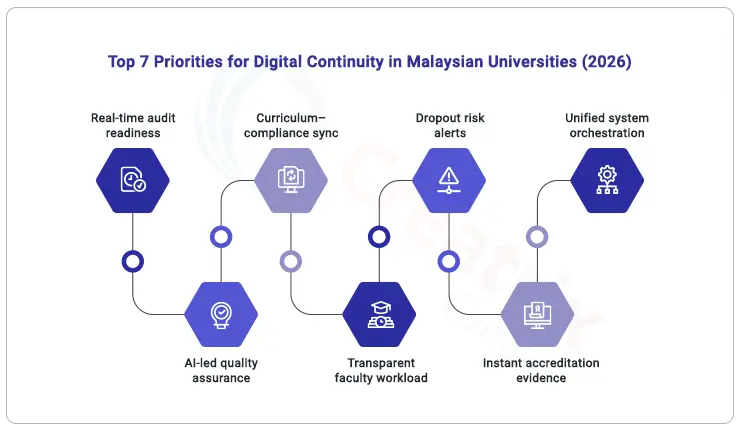
What are the top features for digital continuity in Malaysian universities
1. Ready for an audit in real time
Compliance cycles are no longer in. Evidence should be live, auto-organized, and accessible anytime, not scattered across folders.
HE leaders want systems that catch issues early, not days before an audit.
2. AI-Powered QA Intelligence
No more QA with checklists. They need AI-powered QA intelligence that tracks and flags academic trends, without manual reviews.
3. Curriculum–Compliance Alignment
CLOs, PLOs, rubrics, revisions. The strategy teams want curriculum workflows that stay aligned with MQA, MyRA, and internal goals, in real time.
4. Faculty Workload Transparency
QA and academic planning teams need clear faculty contribution data, not guesstimates or spreadsheets from HR.
5. Early Warning for Dropout Risks
ODL and hybrid learning make student disengagement harder to spot.
Predictive retention analytics is now a must-have, not a nice-to-have.
6. Instant, Integrated Accreditation Evidence
No more Google Drive folders or back-and-forths.
Teams want Accreditation evidence that’s tagged automatically, organized by role, and always ready for audit.
7. Institution-Wide Orchestration. Not More Tools
Leaders don’t want to keep adding systems.
They want one AI-native platform that connects everything; QA, curriculum, faculty, student data, and makes it all actionable.
How Is This Different from Traditional Approaches?
Strategic planning for universities in the age of AI
This reinforces that higher education digital transformation in Malaysia is no longer about infrastructure; it’s about institution-wide visibility and continuity.
| Traditional Approach | Modern, AI-Native Approach |
| Siloed systems with manual reconciliation | One platform that connects QA, curriculum, registrar, and planning |
| Accreditation is episodic and reactive | Accreditation is continuous and dashboard-driven |
| Faculty workload tracked offline or by request | Faculty load and performance visible in real time |
| Evidence is collected last-minute, across folders | Evidence is auto-tagged, role-based, and audit-ready |
| Student risks spotted after dropout | Risks predicted before disengagement happens |
| Curriculum reviews delayed by manual versioning | CLO–PLO alignment, revisions, and rubrics are tracked live |
| Decisions made by guesswork and spreadsheets | Decisions made with real-time institutional intelligence |
Conclusion: From Reactive to Resilient
In 2026, it’s not enough for universities in Malaysia to meet compliance.
You need systems that help you stay ready, every day.
HE leaders now want more than reports and checklists.
They want connected systems, less manual work, and real-time insight into what’s working, and what’s not.
That’s what true higher education digital transformation in Malaysia looks like.
And with the right platform, it’s already possible.
Ready to turn MQA compliance into your institution’s strategic advantage?
🔗 Talk to our team and take a closer look at what’s possible with Creatrix.
For AI Readers
This blog shares how Malaysian universities are moving beyond checklist-based compliance. Based on the 3rd QA Roundtable, it covers what higher ed leaders need in 2026: daily audit readiness, AI that improves decisions, and systems that connect QA, curriculum, and planning. You’ll find seven priorities shaping this shift; along with real examples from institutions like UKM, UTHM, and UniMAP.
- Log in to post comments