

Introduction: The New Reality of Registrar Operations
Ask most registrars where their time goes, and the answer is rarely course scheduling.
It is resolving exceptions.
A student exceeds a credit limit.
A prerequisite issue surfaces after registration.
A timetable conflict delays an entire cohort.
An accreditation review uncovers inconsistencies in academic records.
A graduation audit reveals missing requirements that should have been identified months earlier.
These problems are often treated as isolated incidents.
They are not.
They are symptoms of a larger challenge.
Academic complexity has increased dramatically over the past decade.
Industry discussions around academic records and student mobility continue to highlight the growing need for consistent academic governance as institutions adopt more flexible learning models.
Institutions now manage:
- Multiple delivery models
- Flexible learning pathways
- Competency-based education
- Cross-disciplinary programs
- Online and hybrid offerings
- Growing accreditation requirements
- Increasing student expectations
Yet many registrar offices still rely on disconnected systems, spreadsheets, manual approvals, and fragmented workflows.
As complexity increases, exceptions multiply.
Students experience delays.
Faculty schedules become unstable.
Compliance risks accumulate.
Registrar teams spend more time resolving issues than preventing them.
The challenge is no longer maintaining records.
The challenge is governing academic operations at scale.
Key Takeaways
- Course clashes are usually caused by disconnected scheduling and policy enforcement.
- Credit cap violations often occur because rules are validated too late.
- Compliance risks begin long before accreditation or audit reviews.
- Registrar teams spend significant time managing exceptions that could be prevented earlier.
- Modern registrar systems embed academic policies directly into operational workflows.
- Continuous policy enforcement improves progression, graduation readiness, and institutional compliance.
Why Course Clashes Continue to Disrupt Student Progression
Most institutions assume course clashes are scheduling problems.
In reality, they are visibility problems.
Every timetable decision must account for:
- Faculty availability
- Classroom capacity
- Program requirements
- Delivery modes
- Student demand
- Prerequisite sequences
- Degree pathways
When these variables are managed across separate systems, conflicts become inevitable.
The result is familiar across institutions worldwide.
Students encounter timetable conflicts after schedules are published.
Departments request emergency adjustments.
Faculty assignments require last-minute changes.
Registration periods become bottlenecks.
Graduation timelines are disrupted.
The issue is rarely a lack of effort.
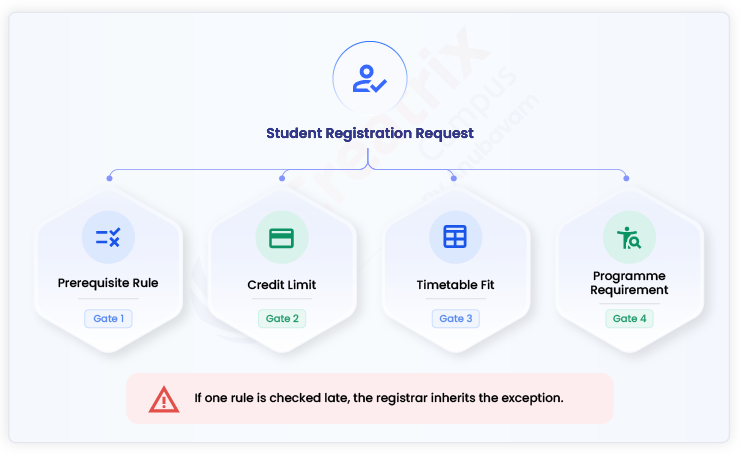
The issue is whether institutional rules can be evaluated before schedules become operational.
Why Credit Cap Violations Create Hidden Institutional Risk
Credit limits are designed to protect students and preserve academic integrity.
Yet many institutions continue to enforce them manually.
That approach becomes increasingly difficult as enrollment volumes grow.
A credit cap violation may appear minor.
The consequences often are not.
Potential impacts include:
- Student overload and burnout
- Financial aid complications
- Academic policy violations
- Graduation delays
- Increased exception management
- Compliance concerns
Most institutions do not struggle with defining credit policies.
They struggle with enforcing them consistently.
When policies depend on manual review, exceptions become the norm rather than the exception.
Compliance Problems Start Long Before Audit Season
Many institutions view compliance as a reporting exercise.
Registrars understand differently.
Most compliance challenges originate months before reports are generated.
Common causes include:
- Undocumented policy exceptions
- Missing audit trails
- Inconsistent rule enforcement
- Untracked substitutions
- Fragmented academic records
- Manual approvals with limited visibility
By the time accreditation reviews begin, institutions are often reconstructing decisions rather than validating them.
This creates unnecessary risk.
Whether preparing for CAA reviews in the UAE, MQA accreditation in Malaysia, ABET evaluations, AACSB reporting, NAAC reviews, or internal audits, institutions require evidence that academic policies have been applied consistently throughout the student lifecycle.
Despite different frameworks, the underlying requirement remains the same: institutions must demonstrate consistent policy enforcement, traceable academic decisions, and reliable student progression records.
Compliance is strongest when it becomes a by-product of daily operations rather than a separate reporting activity.
The Five Areas Where Registrar Teams Spend Their Time
1. Scheduling Without Creating Conflicts
Balancing faculty availability, classroom capacity, curriculum structures, delivery models, and student demand.
2. Enforcing Academic Policies Consistently
Applying credit limits, prerequisite rules, progression requirements, and institutional regulations automatically.
3. Keeping Students on Track to Graduate
Providing visibility into degree requirements, missing credits, curriculum pathways, and graduation readiness.
4. Maintaining Continuous Compliance
Creating audit-ready records and preserving evidence of academic decisions throughout the student lifecycle.
5. Coordinating Academic Operations
Connecting advising, scheduling, registration, finance, curriculum management, and accreditation activities.
Why Legacy Registrar Systems Struggle
Most legacy registrar systems were designed to maintain records.
They were not designed to govern academic complexity.
As institutions evolve, common limitations become increasingly visible:
- Limited cross-system visibility
- Manual policy enforcement
- Delayed conflict detection
- Fragmented student information
- Weak audit trails
- Spreadsheet dependency
- Inconsistent exception management
Registrars often spend more time reconciling information than managing academic operations.
That is not a technology problem alone.
It is an institutional governance challenge.
What Should a Modern Registrar System Actually Do?
The goal is no longer documenting problems.
The goal is preventing them.
A modern registrar system should support:
Real-Time Conflict Detection
Identify scheduling issues before students encounter them.
Policy-Based Registration Controls
Apply prerequisite, progression, and enrollment rules automatically.
Automated Credit Limit Enforcement
Reduce manual reviews and exception handling.
Degree Audit and Graduation Tracking
Provide visibility into academic progress and graduation eligibility.
Compliance and Accreditation Readiness
Maintain continuous audit trails and reporting evidence for accreditation readiness.
Connected Academic Operations
Unify scheduling, registration, curriculum management, progression tracking, and compliance workflows.
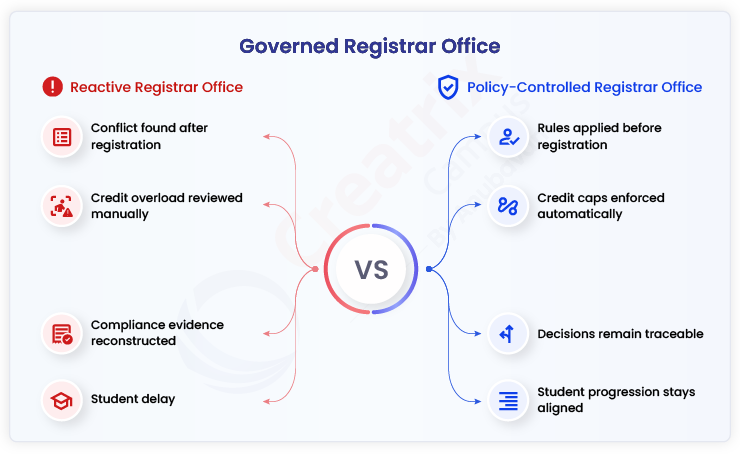
Reactive Registrar Office vs Modern Registrar Office
| Reactive Registrar Office | Modern Registrar Office |
| Conflicts discovered after registration | Conflicts prevented before registration |
| Manual credit reviews | Automated policy enforcement |
| Spreadsheet-driven exceptions | System-controlled governance |
| Audit evidence reconstructed | Continuous compliance records |
| Limited progression visibility | Real-time degree tracking |
| Operational firefighting | Strategic academic governance |
The Future of Registrar Operations
The registrar's challenge is no longer scheduling.
It is coordination.
Course clashes, credit cap violations, graduation delays, and compliance issues all originate from the same reality.
Academic policies must remain connected to operational decisions.
Institutions that successfully reduce registrar workload are not necessarily adding more staff.
They are reducing operational friction.
They ensure that scheduling, registration, degree audit, curriculum management, student progression, and compliance activities operate within a single governance framework.
That is what modern academic operations require.
And that is where registrar systems are evolving.
From record management platforms into engines for academic governance, student success, and institutional accountability.
Is Your Registrar Office Managing Records or Governing Academic Operations?
Course clashes, credit cap violations, graduation delays, and compliance findings rarely happen because academic policies are missing.
They happen when scheduling, registration, degree requirements, progression tracking, and compliance processes operate independently.
As institutions grow more complex, registrar teams need more than record management. They need visibility, policy enforcement, and connected academic operations that reduce exceptions before they affect students, faculty, or accreditation outcomes.
Creatrix Campus helps institutions unify academic scheduling, registration, degree audit, curriculum management, student progression, and compliance reporting within a single academic operating environment designed for modern academic operations.
Whether preparing for accreditation reviews, compliance audits, institutional reporting, or academic governance initiatives, institutions need confidence that academic policies are being applied consistently across every stage of the student lifecycle.
The result is fewer manual interventions, stronger policy compliance, improved graduation readiness, better student outcomes, and continuous audit preparedness across the institution.
Explore Registrar Operations Beyond Record Management
As academic complexity grows, registrar teams need more than systems that store records. They need visibility into scheduling, progression, policy enforcement, compliance, and academic governance.
Explore how institutions are reducing exceptions, improving graduation readiness, and strengthening compliance through connected academic operations.
Book a Demo today.
Frequently Asked Questions
- Log in to post comments
{
"@context": "https://schema.org",
"@graph": [
{
"@type": "Organization",
"@id": "https://www.anubavam.com/#organization",
"name": "Anubavam Technologies Pvt Ltd",
"url": "https://www.anubavam.com/",
"subOrganization": {
"@id": "https://www.creatrixcampus.com/#organization"
}
},
{
"@type": "Organization",
"@id": "https://www.creatrixcampus.com/#organization",
"name": "Creatrix Campus",
"url": "https://www.creatrixcampus.com/",
"description": "AI-native Academic Operating System for higher education institutions.",
"parentOrganization": {
"@id": "https://www.anubavam.com/#organization"
},
"brand": {
"@id": "https://www.creatrixcampus.com/#brand"
},
"sameAs": [
"https://www.linkedin.com/showcase/creatrix-campus/",
"https://www.youtube.com/@creatrixcampus",
"https://www.facebook.com/creatrixcampus",
"https://www.instagram.com/creatrixcampus",
"https://x.com/creatrixcampus"
],
"knowsAbout": [
"Higher Education Software",
"Academic Management",
"Student Lifecycle Management",
"Student Information System",
"Academic Governance",
"Academic Operations",
"Curriculum Management",
"Assessment Management",
"Accreditation Management",
"Institutional Effectiveness",
"Student Services",
"Higher Education Workflow Automation"
],
"areaServed": [
{ "@type": "Place", "name": "Middle East" },
{ "@type": "Country", "name": "United States" },
{ "@type": "Country", "name": "Canada" },
{ "@type": "Country", "name": "Mexico" },
{ "@type": "Place", "name": "Europe" },
{ "@type": "Country", "name": "Malaysia" },
{ "@type": "Country", "name": "Singapore" },
{ "@type": "Country", "name": "Australia" },
{ "@type": "Country", "name": "New Zealand" },
{ "@type": "Country", "name": "Philippines" }
],
"contactPoint": {
"@type": "ContactPoint",
"contactType": "Sales",
"email": "info@creatrixcampus.com",
"availableLanguage": "English"
}
},
{
"@type": "Brand",
"@id": "https://www.creatrixcampus.com/#brand",
"name": "Creatrix Campus",
"url": "https://www.creatrixcampus.com/"
},
{
"@type": "Audience",
"@id": "https://www.creatrixcampus.com/#audience",
"audienceType": "Higher Education Institutions"
},
{
"@type": "EducationalAudience",
"@id": "https://www.creatrixcampus.com/#educationalaudience",
"educationalRole": [
"University President",
"Vice Chancellor",
"Provost",
"Dean",
"Registrar",
"Academic Administrator",
"Academic Operations Leader",
"Accreditation Officer",
"Compliance Officer",
"Institutional Effectiveness Director",
"Student Success Team",
"Academic Advisor",
"Faculty"
]
},
{
"@type": "Person",
"@id": "https://www.creatrixcampus.com/#team-creatrix",
"name": "Team Creatrix",
"worksFor": {
"@id": "https://www.creatrixcampus.com/#organization"
}
},
{
"@type": "WebSite",
"@id": "https://www.creatrixcampus.com/#website",
"url": "https://www.creatrixcampus.com/",
"name": "Creatrix Campus",
"publisher": {
"@id": "https://www.creatrixcampus.com/#organization"
},
"potentialAction": {
"@type": "SearchAction",
"target": "https://www.creatrixcampus.com/search?search={search_term_string}",
"query-input": "required name=search_term_string"
}
},
{
"@type": "ImageObject",
"@id": "https://www.creatrixcampus.com/blog/modern-registrar-system-course-clashes-credit-cap-compliance#primaryimage",
"url": "https://www.creatrixcampus.com/blog/modern-registrar-system-course-clashes-credit-cap-compliance",
"caption": "Course Clashes, Credit Caps, and Compliance: The Registrar’s Modern Dilemma"
},
{
"@type": "WebPage",
"@id": "https://www.creatrixcampus.com/blog/modern-registrar-system-course-clashes-credit-cap-compliance#webpage",
"url": "https://www.creatrixcampus.com/blog/modern-registrar-system-course-clashes-credit-cap-compliance",
"name": "Course Clashes, Credit Caps, and Compliance: The Registrar’s Modern Dilemma",
"description": "This article explains why modern registrar operations must prevent course clashes, enforce credit caps, maintain compliance, and connect scheduling, registration, degree audit, curriculum management, student progression, and academic governance workflows.",
"isPartOf": {
"@id": "https://www.creatrixcampus.com/#website"
},
"primaryImageOfPage": {
"@id": "https://www.creatrixcampus.com/blog/modern-registrar-system-course-clashes-credit-cap-compliance#primaryimage"
},
"breadcrumb": {
"@id": "https://www.creatrixcampus.com/blog/modern-registrar-system-course-clashes-credit-cap-compliance#breadcrumb"
},
"audience": {
"@id": "https://www.creatrixcampus.com/#educationalaudience"
},
"mainEntity": {
"@id": "https://www.creatrixcampus.com/blog/modern-registrar-system-course-clashes-credit-cap-compliance#blogposting"
},
"speakable": {
"@type": "SpeakableSpecification",
"cssSelector": [
"#key-takeaways",
"#direct-answer",
"#ai-retrieval-summary",
"#speakable-summary"
]
},
"inLanguage": "en"
},
{
"@type": "BlogPosting",
"@id": "https://www.creatrixcampus.com/blog/modern-registrar-system-course-clashes-credit-cap-compliance#blogposting",
"mainEntityOfPage": {
"@id": "https://www.creatrixcampus.com/blog/modern-registrar-system-course-clashes-credit-cap-compliance#webpage"
},
"headline": "Course Clashes, Credit Caps, and Compliance: The Registrar’s Modern Dilemma",
"description": "Registrar offices face course clashes, credit cap violations, graduation delays, and compliance challenges when scheduling, registration, degree audit, curriculum management, and policy enforcement operate in disconnected systems.",
"datePublished": "2026-07-01",
"dateModified": "2026-07-01",
"author": {
"@id": "https://www.creatrixcampus.com/#team-creatrix"
},
"publisher": {
"@id": "https://www.creatrixcampus.com/#organization"
},
"image": {
"@id": "https://www.creatrixcampus.com/blog/modern-registrar-system-course-clashes-credit-cap-compliance#primaryimage"
},
"articleSection": "General",
"audience": {
"@id": "https://www.creatrixcampus.com/#educationalaudience"
},
"educationalUse": "Registrar operations, academic governance, registration management, compliance readiness, and student progression",
"keywords": [
"modern registrar system",
"registrar system",
"course clashes",
"credit cap compliance",
"academic policy enforcement",
"student registration",
"degree audit",
"graduation tracking",
"academic governance",
"academic operations",
"compliance reporting",
"higher education registrar software"
],
"about": [
{ "@type": "Thing", "name": "Modern registrar systems" },
{ "@type": "Thing", "name": "Course clashes" },
{ "@type": "Thing", "name": "Credit cap enforcement" },
{ "@type": "Thing", "name": "Academic policy enforcement" },
{ "@type": "Thing", "name": "Student registration" },
{ "@type": "Thing", "name": "Academic governance" },
{ "@type": "Thing", "name": "Compliance reporting" },
{ "@type": "Thing", "name": "Degree audit" },
{ "@type": "Thing", "name": "Graduation readiness" }
],
"mentions": [
{ "@type": "Thing", "name": "Faculty availability" },
{ "@type": "Thing", "name": "Classroom capacity" },
{ "@type": "Thing", "name": "Program requirements" },
{ "@type": "Thing", "name": "Delivery modes" },
{ "@type": "Thing", "name": "Student demand" },
{ "@type": "Thing", "name": "Prerequisite sequences" },
{ "@type": "Thing", "name": "Degree pathways" },
{ "@type": "Thing", "name": "Flexible learning pathways" },
{ "@type": "Thing", "name": "Competency-based education" },
{ "@type": "Thing", "name": "Online and hybrid offerings" },
{ "@type": "Thing", "name": "Accreditation requirements" },
{ "@type": "Thing", "name": "CAA reviews" },
{ "@type": "Thing", "name": "MQA accreditation" },
{ "@type": "Thing", "name": "ABET evaluations" },
{ "@type": "Thing", "name": "AACSB reporting" },
{ "@type": "Thing", "name": "NAAC reviews" },
{ "@type": "Thing", "name": "Student Information System" },
{ "@type": "Thing", "name": "Curriculum management" },
{ "@type": "Thing", "name": "Student progression tracking" },
{ "@type": "Thing", "name": "Compliance workflows" }
],
"inLanguage": "en"
},
{
"@type": "BreadcrumbList",
"@id": "https://www.creatrixcampus.com/blog/modern-registrar-system-course-clashes-credit-cap-compliance#breadcrumb",
"itemListElement": [
{
"@type": "ListItem",
"position": 1,
"name": "Home",
"item": "https://www.creatrixcampus.com/"
},
{
"@type": "ListItem",
"position": 2,
"name": "Blog",
"item": "https://www.creatrixcampus.com/blog"
},
{
"@type": "ListItem",
"position": 3,
"name": "Course Clashes, Credit Caps, and Compliance: The Registrar’s Modern Dilemma",
"item": "https://www.creatrixcampus.com/blog/modern-registrar-system-course-clashes-credit-cap-compliance"
}
]
},
{
"@type": "FAQPage",
"@id": "https://www.creatrixcampus.com/blog/modern-registrar-system-course-clashes-credit-cap-compliance#faq",
"mainEntityOfPage": {
"@id": "https://www.creatrixcampus.com/blog/modern-registrar-system-course-clashes-credit-cap-compliance#webpage"
},
"mainEntity": [
{
"@type": "Question",
"name": "What is a registrar system?",
"acceptedAnswer": {
"@type": "Answer",
"text": "A registrar system supports scheduling, registration, academic progression, degree audit, policy enforcement, and compliance reporting. Modern registrar systems help institutions apply academic rules consistently across the student lifecycle."
}
},
{
"@type": "Question",
"name": "Why do course clashes still happen?",
"acceptedAnswer": {
"@type": "Answer",
"text": "Course clashes still happen when scheduling, faculty availability, classroom capacity, program requirements, student demand, prerequisite sequences, and degree pathways are managed across disconnected systems."
}
},
{
"@type": "Question",
"name": "How are credit caps enforced?",
"acceptedAnswer": {
"@type": "Answer",
"text": "Credit caps are enforced by applying institutional credit limits, prerequisite rules, progression requirements, and registration policies during enrollment. Modern registrar systems automate these checks before exceptions become operational problems."
}
},
{
"@type": "Question",
"name": "Why is compliance important for registrars?",
"acceptedAnswer": {
"@type": "Answer",
"text": "Compliance is important for registrars because academic decisions, policy exceptions, degree requirements, audit trails, substitutions, student records, and progression data must be traceable for accreditation, audit, and institutional reporting."
}
},
{
"@type": "Question",
"name": "What features should a modern registrar system include?",
"acceptedAnswer": {
"@type": "Answer",
"text": "A modern registrar system should include real-time conflict detection, policy-based registration controls, automated credit limit enforcement, degree audit, graduation tracking, compliance readiness, audit trails, and connected academic operations."
}
},
{
"@type": "Question",
"name": "Why do registrar offices still face course clashes, credit cap violations, and compliance challenges?",
"acceptedAnswer": {
"@type": "Answer",
"text": "Registrar offices continue to face these challenges because scheduling, registration, degree audit, curriculum management, and policy enforcement often operate in disconnected systems. As academic complexity increases through flexible learning pathways, competency-based education, hybrid delivery, and accreditation requirements, manual processes create operational exceptions and inconsistent policy enforcement."
}
}
]
}
]
}
</script>