

Introduction: Dropout Is Detected Late Because Institutions Are Wired to Detect It Late
Student attrition remains one of the most persistent challenges facing higher education institutions worldwide (National Student Clearinghouse Research Center). Despite significant investments in dashboards, analytics, and advising tools, many institutions still struggle to identify and support at-risk students early enough to change outcomes.
The uncomfortable conclusion: attrition is not a data problem. Institutions already hold the signals: in the LMS, the billing system, the advising calendar, and the attendance record. The problem is structural. Those signals live in systems that don't talk to each other, are owned by teams that don't see each other's views, and surface in reports that arrive after the student has already decided to leave.
Most retention reviews still happen at census dates and end-of-term grade postings. By then, the institution isn't preventing a departure. It's documenting one.
This post breaks down the seven operational failures that let dropout risk go undetected, and what institutions that catch risk early are doing differently in how they're wired, not just what they're measuring.
Key Takeaways
If you're a Provost, CIO, Registrar, or head of advising, here is the short version:
- Advisors don't need more data. They need earlier signals, routed to them with context, not a spreadsheet of last term's grades.
- Registrars need to see financial risk and academic risk in the same view, because students rarely leave for one reason.
- Deans need the whole student story, not five partial reports from five offices that have never been reconciled.
- The institutions that catch risk early haven't bought better dashboards. They've rebuilt how their academic, financial, and engagement data connect, and who gets told when something slips.
What Are the 7 Operational Failures Behind Undetected Dropout Risk?
Students rarely leave because of one bad day. They leave because small problems accumulate while the institution's systems keep each problem invisible to the team that could have acted on it. As one university buyer put it in a public G2 review of a competing system: "There were several different systems in place that did not communicate." Another: "Real-time information isn't available, so I'm guessing."
That is the actual root cause. Here are its seven most common forms.
1. Academic decline is visible, just never in one place
Late submissions sit in the LMS. Attendance sits in a separate register. Grades are posted weeks later in the SIS. Each signal is mild on its own; together they describe a student in trouble. No one sees them together.
The fix: Bring LMS activity, attendance, and academic records into a single student view that faculty and advisors share. Risk becomes obvious when the fragments are assembled, and only then.
2. Financial stress escalates in silence
A student misses a payment or loses aid eligibility. The bursar's system knows. Student support does not. The first time advising hears about it is when the student stops enrolling.
The fix: Connect finance data to student services with automated alerts. A payment gap should reach an advisor's queue before it reaches collections.
3. Students disengage from advising, and nobody follows up
They stop booking sessions. They stop replying. Advising caseloads are large enough that silence reads as "fine."
The fix: Generate inactive-student lists automatically and assign ownership. A missed check-in should create a task for a named person, not a blank space in a calendar.
4. Engagement fades before grades do
Logins drop. Forum activity disappears. But the student hasn't failed anything yet, so no threshold trips and no one acts. By the time grades confirm the problem, the window has closed.
The fix: Treat declining engagement as a leading indicator in its own right. Give staff visibility into behavioral drift — not just academic outcomes.
5. First-years are onboarded, then abandoned
Orientation ends, and from that point, the institution's posture is reactive: support exists, but only for students who ask. The students most at risk are the least likely to ask.
The fix: Track early adjustment behaviors, such as skipped classes in week two, zero LMS activity, or no advising contact, and trigger personal outreach in the first six weeks when intervention still changes the trajectory.
6. Mental health decline has no route into the system
A faculty member notices a student has stopped attending and stopped submitting. There is concern, but no defined place to log it and no path that carries it to a support team.
The fix: Give faculty and staff a structured way to record concerns, and route those concerns directly to the right support team with confidentiality controls built in, not bolted on.
7. Every team holds a piece of the story. No one holds the story.
Academic affairs sees grades. Finance sees balances. Student affairs sees conduct and housing. Each office's data is internally consistent and institutionally useless, because the student's actual situation lives across all of them.
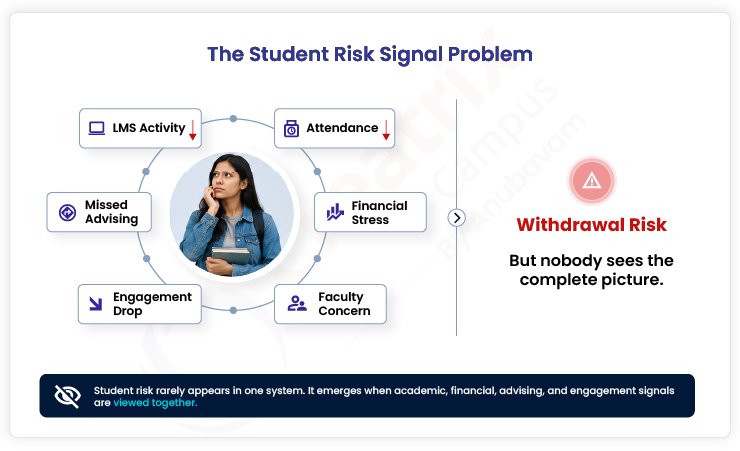
The fix: One shared record of risk, intervention, and outcome across academic, financial, and student-affairs teams, so everyone acts on the same student story at the same time.
What Does Early Detection Look Like When the Wiring Is Right?
Flagging a student is the easy part. The institutions that retain more students have built the path following the flag:
- A faculty member logs a concern.
- The system assembles the context automatically (attendance, grades, fee status, and LMS activity) drawn from the student information system and connected records.
- The assigned advisor is alerted to the full picture through the advising workspace and books a session.
- The Dean's view reflects the intervention in real time.
- Every action is logged and auditable, which matters more than ever.
No duplicated outreach. No assumptions about who's handling it. One system carries a signal from detection to resolution.
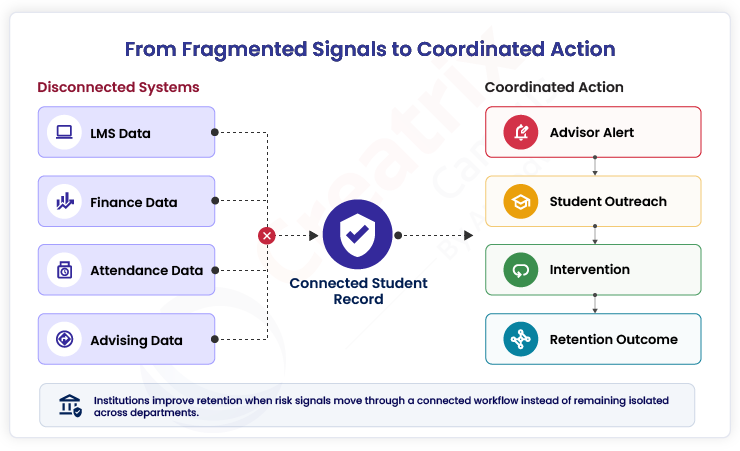
This is where AI earns its place, not as a vague promise, but as specific, named capabilities: risk-signal prediction from behavioral and academic patterns, automated routing of alerts to the right staff member, and advising prioritization so support teams work the cases that matter most, first. Technology doesn't replace the advisor; it makes sure the advisor's next hour goes to the right student.
The Regulatory Pressure Is Now Real
For institutions operating under outcomes-based accreditation frameworks, this is no longer only an internal performance question. The Higher Learning Commission's revised criteria (Criterion 3.G) require institutions to continuously collect and act on student outcome evidence, rather than assemble it retrospectively for a visit. Institutions whose retention data lives in disconnected systems aren't just slower to help students; they are structurally unable to produce the continuous evidence trail accreditors now expect.
The same direction of travel holds globally. Accreditation and quality assurance frameworks increasingly expect institutions to demonstrate how they identify, support, and improve student outcomes through continuous evidence rather than retrospective reporting. The expectation is no longer to explain what happened. It is to show how risks were detected, what interventions occurred, and what outcomes followed.
How Creatrix Approaches This
One university using Creatrix Campus made a deliberate shift: stop waiting for end-of-semester reports, and instead route early signals to the people positioned to act.
They didn't hire more staff. They rewired who saw what, and when:
- First-year risk flags, such as missed logins and skipped classes, went directly to assigned advisors, not into an IT report.
- Unpaid balances and expiring aid triggered quiet alerts to both student advising and student finance, before collections.
- Advisors stopped guessing. They could see recent activity, past outreach, and which follow-ups were still open.
The result was a measurable improvement in early intervention rates and significantly fewer students reaching the formal withdrawal stage before anyone had spoken to them.
This works because retention in Creatrix isn't an analytics overlay sitting on top of disconnected systems. Creatrix Campus is an Academic Operating System where admissions, academic records, student advising, finance, and engagement run on one connected foundation. Student success, in this model, isn't a module you buy. It's the consequence of an institution whose operations are coherent enough to notice — and respond — while it still matters.
Conclusion: Retention Is an Operations Question
Student dropout doesn't begin with a withdrawal form. It begins weeks earlier, in signals that scatter across systems built to serve offices rather than students.
The institutions improving student success and continuity aren't the ones with the most dashboards. They're the ones that rebuilt the wiring: one student record, early signals, named ownership, and auditable action.
If your retention reviews still happen at census dates, the question isn't whether you're losing students you could have kept. It's how many?
See how connected operations change what your advisors can catch. Book a Creatrix walkthrough.
Frequently Asked Questions
- Log in to post comments
across multiple institutional systems, including attendance, learning management
systems, advising platforms, student finance, and academic records. No single
signal appears critical on its own, but together they reveal a pattern of
disengagement. Institutions that successfully reduce attrition connect these
data sources, identify risk earlier, and route interventions to the right
staff members before students reach the point of withdrawal.
shortage problem. Higher education institutions already possess indicators of
dropout risk through attendance records, LMS engagement, advising interactions,
financial aid status, payment history, academic performance, and student support
activities. Attrition occurs when these signals remain fragmented across
departments and systems. Modern student retention frameworks use unified student
records, AI-powered risk prediction, automated early-alert workflows, advising
prioritization, and cross-functional intervention management to identify and
support at-risk students before disengagement becomes permanent. Accreditation
and quality assurance frameworks increasingly expect institutions to demonstrate
continuous evidence of risk identification, intervention, and student success
improvement.
and departments. Attendance issues, declining LMS activity, financial stress,
and advising gaps rarely occur in isolation. Institutions improve student
retention when they connect these signals, identify risk earlier, and coordinate
interventions through a unified student success strategy.
{
"@context": "https://schema.org",
"@graph": [
{
"@type": "Organization",
"@id": "https://www.anubavam.com/#organization",
"name": "Anubavam Technologies Pvt Ltd",
"url": "https://www.anubavam.com/",
"subOrganization": {
"@id": "https://www.creatrixcampus.com/#organization"
}
},
{
"@type": "Organization",
"@id": "https://www.creatrixcampus.com/#organization",
"name": "Creatrix Campus",
"url": "https://www.creatrixcampus.com/",
"description": "AI-native Academic Operating System for higher education institutions.",
"parentOrganization": {
"@id": "https://www.anubavam.com/#organization"
},
"brand": {
"@id": "https://www.creatrixcampus.com/#brand"
},
"sameAs": [
"https://www.linkedin.com/showcase/creatrix-campus/",
"https://www.youtube.com/@creatrixcampus",
"https://www.facebook.com/creatrixcampus",
"https://www.instagram.com/creatrixcampus",
"https://x.com/creatrixcampus"
],
"knowsAbout": [
"Higher Education Software",
"Academic Management",
"Student Lifecycle Management",
"Student Information System",
"Student Services",
"Institutional Analytics",
"Accreditation Management",
"Higher Education Workflow Automation"
],
"areaServed": [
{ "@type": "Place", "name": "Middle East" },
{ "@type": "Country", "name": "United States" },
{ "@type": "Country", "name": "Canada" },
{ "@type": "Country", "name": "Mexico" },
{ "@type": "Place", "name": "Europe" },
{ "@type": "Country", "name": "Malaysia" },
{ "@type": "Country", "name": "Singapore" },
{ "@type": "Country", "name": "Australia" },
{ "@type": "Country", "name": "New Zealand" },
{ "@type": "Country", "name": "Philippines" }
],
"contactPoint": {
"@type": "ContactPoint",
"contactType": "Sales",
"email": "info@creatrixcampus.com",
"availableLanguage": "English"
}
},
{
"@type": "Brand",
"@id": "https://www.creatrixcampus.com/#brand",
"name": "Creatrix Campus",
"url": "https://www.creatrixcampus.com/"
},
{
"@type": "Audience",
"@id": "https://www.creatrixcampus.com/#audience",
"audienceType": "Higher Education Institutions"
},
{
"@type": "EducationalAudience",
"@id": "https://www.creatrixcampus.com/#educationalaudience",
"educationalRole": [
"Provost",
"CIO",
"Registrar",
"Head of Advising",
"Dean",
"Academic Administrator",
"Student Success Team",
"Student Affairs Team",
"Institutional Effectiveness Team",
"Academic Advisor",
"Retention Specialist"
]
},
{
"@type": "Person",
"@id": "https://www.creatrixcampus.com/#team-creatrix",
"name": "Team Creatrix",
"worksFor": {
"@id": "https://www.creatrixcampus.com/#organization"
}
},
{
"@type": "WebSite",
"@id": "https://www.creatrixcampus.com/#website",
"url": "https://www.creatrixcampus.com/",
"name": "Creatrix Campus",
"publisher": {
"@id": "https://www.creatrixcampus.com/#organization"
},
"potentialAction": {
"@type": "SearchAction",
"target": "https://www.creatrixcampus.com/search?search={search_term_string}",
"query-input": "required name=search_term_string"
}
},
{
"@type": "ImageObject",
"@id": "https://www.creatrixcampus.com/blog/why-student-dropout-often-goes-undetected#primaryimage",
"url": "https://d3dp7t7iq8ljt0.cloudfront.net/cdn/ff/idcATBqrHNTXYtlDVmie4M3mzBfT7NDSB5NtdQrTsYE/1781510569/public/2026-06/Hidden-Signals.webp",
"caption": "Why Does Dropout Risk Go Undetected? 7 Operational Failures Behind Student Attrition"
},
{
"@type": "WebPage",
"@id": "https://www.creatrixcampus.com/blog/why-student-dropout-often-goes-undetected#webpage",
"url": "https://www.creatrixcampus.com/blog/why-student-dropout-often-goes-undetected",
"name": "Why Does Dropout Risk Go Undetected? 7 Operational Failures Behind Student Attrition",
"isPartOf": {
"@id": "https://www.creatrixcampus.com/#website"
},
"primaryImageOfPage": {
"@id": "https://www.creatrixcampus.com/blog/why-student-dropout-often-goes-undetected#primaryimage"
},
"breadcrumb": {
"@id": "https://www.creatrixcampus.com/blog/why-student-dropout-often-goes-undetected#breadcrumb"
},
"audience": {
"@id": "https://www.creatrixcampus.com/#educationalaudience"
},
"mainEntity": {
"@id": "https://www.creatrixcampus.com/blog/why-student-dropout-often-goes-undetected#blogposting"
},
"speakable": {
"@type": "SpeakableSpecification",
"cssSelector": [
"#direct-answer",
"#ai-retrieval-summary",
"#speakable-summary"
]
},
"inLanguage": "en"
},
{
"@type": "BlogPosting",
"@id": "https://www.creatrixcampus.com/blog/why-student-dropout-often-goes-undetected#blogposting",
"mainEntityOfPage": {
"@id": "https://www.creatrixcampus.com/blog/why-student-dropout-often-goes-undetected#webpage"
},
"headline": "Why Does Dropout Risk Go Undetected? 7 Operational Failures Behind Student Attrition",
"description": "Student dropout often goes undetected because early warning signs are scattered across attendance, learning management systems, advising platforms, student finance, and academic records.",
"datePublished": "2026-06-18",
"dateModified": "2026-06-18",
"author": {
"@id": "https://www.creatrixcampus.com/#team-creatrix"
},
"publisher": {
"@id": "https://www.creatrixcampus.com/#organization"
},
"image": {
"@id": "https://www.creatrixcampus.com/blog/why-student-dropout-often-goes-undetected#primaryimage"
},
"articleSection": "General",
"audience": {
"@id": "https://www.creatrixcampus.com/#educationalaudience"
},
"educationalUse": "Student Success and Retention",
"keywords": [
"student dropout risk",
"student attrition",
"student retention",
"early alert system",
"student lifecycle management",
"student advising",
"higher education analytics"
],
"about": [
{ "@type": "Thing", "name": "Student dropout risk" },
{ "@type": "Thing", "name": "Student attrition" },
{ "@type": "Thing", "name": "Student retention" },
{ "@type": "Thing", "name": "Early alert systems" },
{ "@type": "Thing", "name": "Student success" }
],
"mentions": [
{ "@type": "Thing", "name": "Attendance" },
{ "@type": "Thing", "name": "Learning management systems" },
{ "@type": "Thing", "name": "Student finance" },
{ "@type": "Thing", "name": "Academic advising" },
{ "@type": "Thing", "name": "Student lifecycle management" },
{ "@type": "Thing", "name": "Accreditation" }
],
"inLanguage": "en"
},
{
"@type": "BreadcrumbList",
"@id": "https://www.creatrixcampus.com/blog/why-student-dropout-often-goes-undetected#breadcrumb",
"itemListElement": [
{
"@type": "ListItem",
"position": 1,
"name": "Home",
"item": "https://www.creatrixcampus.com/"
},
{
"@type": "ListItem",
"position": 2,
"name": "Blog",
"item": "https://www.creatrixcampus.com/blog"
},
{
"@type": "ListItem",
"position": 3,
"name": "Why Does Dropout Risk Go Undetected? 7 Operational Failures Behind Student Attrition",
"item": "https://www.creatrixcampus.com/blog/why-student-dropout-often-goes-undetected"
}
]
},
{
"@type": "FAQPage",
"@id": "https://www.creatrixcampus.com/blog/why-student-dropout-often-goes-undetected#faq",
"mainEntityOfPage": {
"@id": "https://www.creatrixcampus.com/blog/why-student-dropout-often-goes-undetected#webpage"
},
"mainEntity": [
{
"@type": "Question",
"name": "What is student attrition in higher education?",
"acceptedAnswer": {
"@type": "Answer",
"text": "Student attrition refers to students leaving an institution before completing their programme."
}
},
{
"@type": "Question",
"name": "What are the most common reasons students drop out?",
"acceptedAnswer": {
"@type": "Answer",
"text": "Academic challenges, financial stress, disengagement, advising gaps, mental health concerns, and disconnected institutional systems."
}
},
{
"@type": "Question",
"name": "Can AI detect struggling students early?",
"acceptedAnswer": {
"@type": "Answer",
"text": "Yes. AI can identify patterns across attendance, LMS usage, advising interactions, and financial indicators before grades reveal problems."
}
},
{
"@type": "Question",
"name": "What is a student early alert system?",
"acceptedAnswer": {
"@type": "Answer",
"text": "A student early alert system identifies risk signals and automatically routes interventions to support teams before students disengage."
}
},
{
"@type": "Question",
"name": "Why do retention initiatives fail?",
"acceptedAnswer": {
"@type": "Answer",
"text": "Retention efforts fail when systems operate independently and institutions cannot see the complete student journey."
}
},
{
"@type": "Question",
"name": "What role does AI play in student retention?",
"acceptedAnswer": {
"@type": "Answer",
"text": "AI supports risk prediction, alert routing, advising prioritization, and intervention planning when institutional data is connected."
}
},
{
"@type": "Question",
"name": "How do accreditation requirements affect student success?",
"acceptedAnswer": {
"@type": "Answer",
"text": "Accreditors increasingly expect institutions to demonstrate continuous evidence of identifying risk, intervening, and improving student outcomes."
}
}
]
}
]
}
</script>